Saturday, August 22, 2015

The Art of Team Building - Part I

The Art of Team Building is a four part series that details my methodical approach to creating and building teams that operate at a high level.  This methodology uses Six Sigma at its foundation, and has served as a recipe for success to transcend all organizations regardless of business type or function.   I hope you enjoy the read as much as I’ve enjoyed documenting the process....

Part I - Precision Team Building Process - Identifying Your Key Players

Throughout my career as a technologist, I have developed and come to rely on a suite of processes that I execute in each new engagement with a company. The first of these processes, Precision Team Building (PTB), is key to the human capital component that helps to identify a team’s strengths and weaknesses.   While you can’t force chemistry, you can most assuredly foster an environment to increase the likelihood dramatically by using the Precision Team Building process.
Producing output similar to the Myers Briggs personality test,  the results of this process prove even more valuable to team leaders due to the specific tailoring to the task at hand. PTB involves asking team members to complete a two-part survey/questionnaire about their proficiencies and experiences across various functions of IT.  The first poll is fairly short, and takes approximately  15-30 minutes to complete.  The second version of the poll is longer, more granular and provides a holistic view into the core of your IT team.  This second series of questions can take anywhere from 45 minutes to an hour.
The motive of the surveys is multi-faceted.  The results provide psychological and sociological data that help develop the blueprint that will be used to build the team. The sum of the whole of any department reveals a distinct personality as a whole unto itself. The blueprint also allows for the handling of low-hanging fruit during the development and execution of the long-term plan and vision for the team. The psychographics created will serve as a general predictor, which forecasts future performance, loyalty, and operating effectiveness.
The goal of the human resource phase of the survey is to analyze the data generated and gauges the “state of the union” as it relates to the technological strengths and weaknesses of the team.  By heat mapping the results, technical areas can be identified that need strengthening through cross training or by purchasing the necessary education for the team to align with the business’ needs.  Heat mapping also provides insight to employees who have  specialized areas of expertise that do not exist within the rest of the team.  These subject matter experts are an organization’s single point of failure.  If something happens to them, the knowledge contained in their brain could be lost.  While some may consider this job security, it can also be seen as an inherent risk to both the employee and the organization they work for.  For the employee, there is a risk of work-life imbalance, burnout, and inhibiting their ability to grow due to the need for constant focus on the specific area of expertise.  For the organization, there is the obvious single point of failure problem, but more important is the fact that because no other team members are cross-trained, the rest of the team suffers.
It is a leader’s responsibility to identify the “tribal knowledge” and ensure its documentation and dissemination across the rest of the IT organization through cross training and knowledge cube creation.  
The output generated by the question and answer exercise can glean significant psychosocial  data from the group that will assist not only in helping you understand the current state of the team, but will also help you identify your top performers.  When executing the survey, ask your leaders to gather 100% participation from their team.  There are obviously extenuating circumstances that could delay the completion of a survey that must be taken into account, but as a general rule, the longer it takes to get 100% participation, the more challenges you will have in assembling your team.
There are several data points to consider here during this phase of the analysis:

The “When” is as important as the “What”

Timely participation can provide you with great insight into your team as a whole, as well as the individual contributors.  As the delta of time increases to gather the results, the amount of time required to prepare the team for the next phase grows in parallel.  Whether a team member completes the survey or not, you will be able to gather information on the current leader and the team as a collective  Some of the data includes:
  • work ethic
  • work load
  • level of respect for their manager
  • morale of the individual
  • morale of the team

Participation will only be as strong as your leaders.

This phase of the process also allows one to observe their leaders in action.  As they work to get their teams to participate and focus on the action to complete the questionnaire, you have an opportunity to observe your leader’s ability to:
  • communicate, both orally as well as written, with their team
  • produce results from a simple task
  • rally the team towards a common goal
  • garner the support of other leaders in the IT organization
At the end of this phase of the process, the information you gathered will reap many benefits.  This phase naturally encourages the cream to rise to the top; your top performers with the best attitudes and drive for success will present themselves plainly to you.  You will have a detailed map of each team member’s strengths and weaknesses, as well as that of the organization as a whole.  Your natural leaders will rise as well; you will have an understanding of each leader’s span of influence and level of respect inside of the organization, and that influence will assist you in uniting the team under a common flag.
Now that you have your map, it’s time to roll up your sleeves and get the team operating at maximum performance.

If the team understands the individual, the individual will also understand themselves as a team.
In future blog releases the following topics will be covered:
Part II - Collaboration, Trust, and Transparency
Part III - Knowledge Cubes & The Art of Foundational Process
Part IV - Autonomy - Fostering Self Determination - The Utopia of Team Building

Friday, July 10, 2015

Google For Work - Case Study


Fostering Innovation in Retail With Google for Work
a study of Chico’s FAS by PwC


1


CONTENTS
Background ................................................................................................................................ 3
Merchandising............................................................................................................................ 4
Planning & Allocation ................................................................................................................. 6
Store Sales & Operations ........................................................................................................... 8
Contact Center ..........................................................................................................................10
Customer Analytics ...................................................................................................................12
Human Resources & Corporate Communications .....................................................................14
References ...............................................................................................................................16
2


BACKGROUND
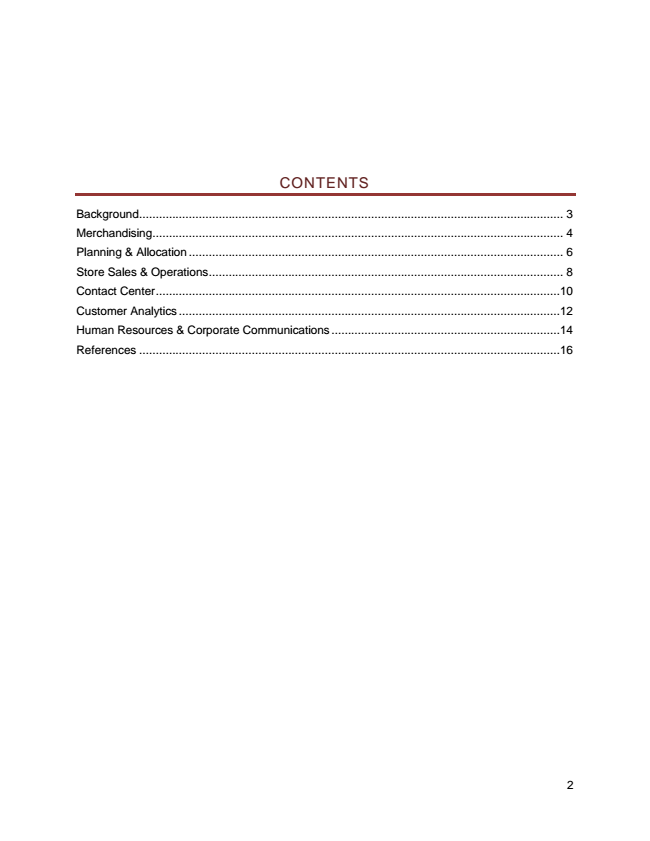
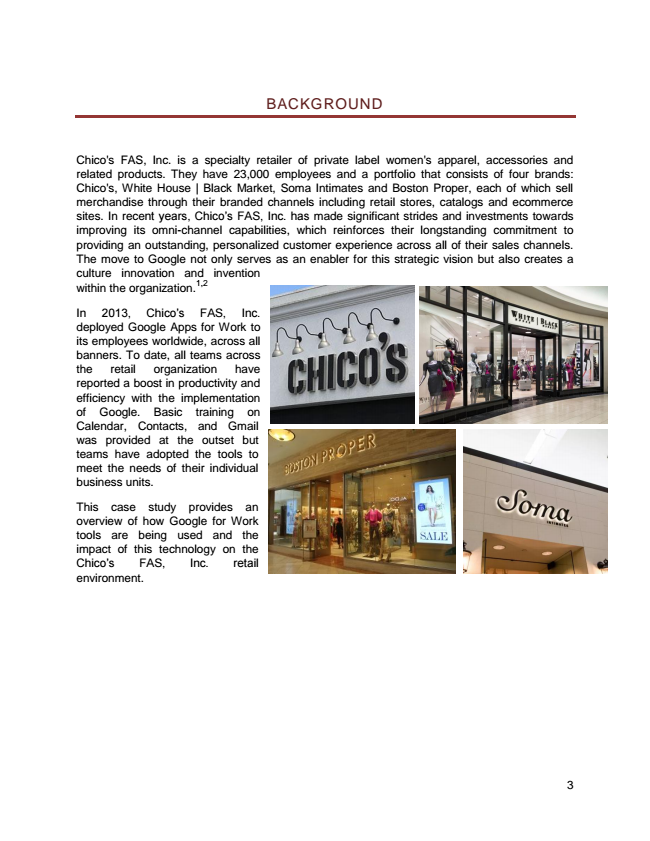
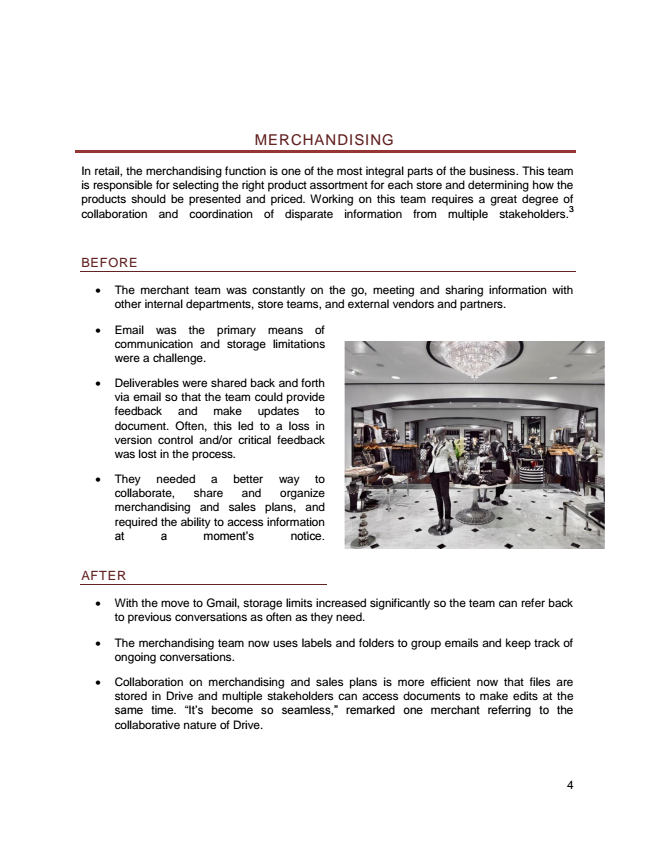
Chico's FAS, Inc. is a specialty retailer of private label women's apparel, accessories and related products. They have 23,000 employees and a portfolio that consists of four brands: Chico's, White House | Black Market, Soma Intimates and Boston Proper, each of which sell merchandise through their branded channels including retail stores, catalogs and ecommerce sites. In recent years, Chico’s FAS, Inc. has made significant strides and investments towards improving its omni-channel capabilities, which reinforces their longstanding commitment to providing an outstanding, personalized customer experience across all of their sales channels. The move to Google not only serves as an enabler for this strategic vision but also creates a culture innovation and invention within the organization.
1,2
In 2013, Chico’s FAS, Inc. deployed Google Apps for Work to its employees worldwide, across all banners. To date, all teams across the retail organization have reported a boost in productivity and efficiency with the implementation of Google. Basic training on Calendar, Contacts, and Gmail was provided at the outset but teams have adopted the tools to meet the needs of their individual business units.
This case study provides an overview of how Google for Work tools are being used and the impact of this technology on the Chico’s FAS, Inc. retail environment.
3


MERCHANDISING
In retail, the merchandising function is one of the most integral parts of the business. This team is responsible for selecting the right product assortment for each store and determining how the products should be presented and priced. Working on this team requires a great degree of collaboration and coordination of disparate information from multiple stakeholders.
3
BEFORE
• The merchant team was constantly on the go, meeting and sharing information with other internal departments, store teams, and external vendors and partners.
• Email was the primary means of communication and storage limitations were a challenge.
• Deliverables were shared back and forth via email so that the team could provide feedback and make updates to document. Often, this led to a loss in version control and/or critical feedback was lost in the process.
• They needed a better way to collaborate, share and organize merchandising and sales plans, and required the ability to access information at a moment’s notice.
AFTER
• With the move to Gmail, storage limits increased significantly so the team can refer back to previous conversations as often as they need.
• The merchandising team now uses labels and folders to group emails and keep track of ongoing conversations.
• Collaboration on merchandising and sales plans is more efficient now that files are stored in Drive and multiple stakeholders can access documents to make edits at the same time. “It’s become so seamless,” remarked one merchant referring to the collaborative nature of Drive.
4


• With Drive, all teams work from a single, shared version of critical documents such as buy sheets, allocation schedules, or visual merchandising planograms. They also have the ability to quickly access documents via their mobile devices when attending off-site meetings with stores and vendors.
I love the ability to link and group emails.
is has de
IMPACT
Gmail introduced a better way of working for a team that relies heavily on email on a daily basis. Merchant teams needed to be able to organize emails from planning teams, stores, and vendors in a logical way and key features of Gmail allowed them to do this. Similarly, Drive streamlined operations by eliminating the need to email multiple versions of merchandising plans among team members, and improved collaboration among this team and other stakeholders.
5


PLANNING & ALLOCATION
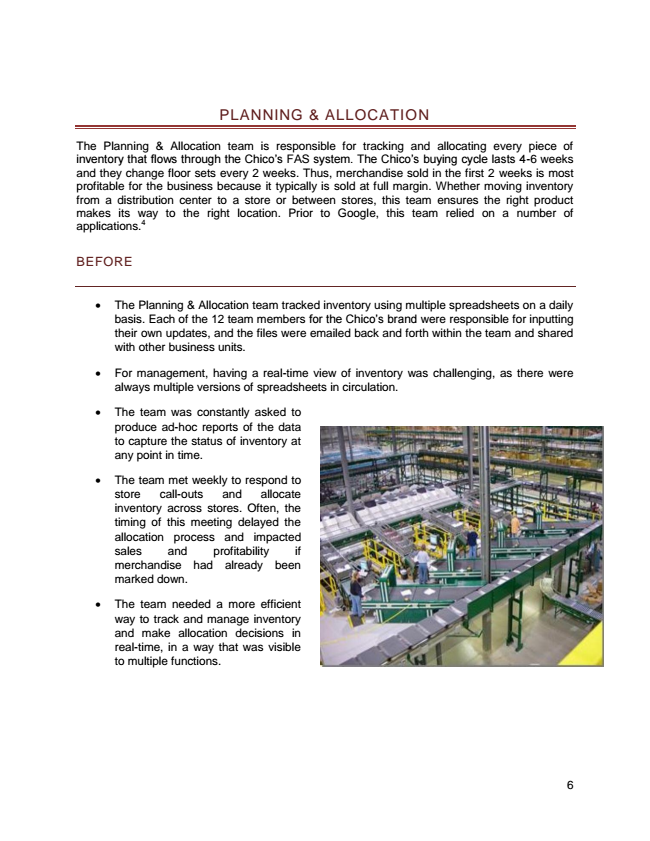
The Planning & Allocation team is responsible for tracking and allocating every piece of inventory that flows through the Chico’s FAS system. The Chico’s buying cycle lasts 4-6 weeks and they change floor sets every 2 weeks. Thus, merchandise sold in the first 2 weeks is most profitable for the business because it typically is sold at full margin. Whether moving inventory from a distribution center to a store or between stores, this team ensures the right product makes its way to the right location. Prior to Google, this team relied on a number of applications.4
BEFORE
• The Planning & Allocation team tracked inventory using multiple spreadsheets on a daily basis. Each of the 12 team members for the Chico’s brand were responsible for inputting their own updates, and the files were emailed back and forth within the team and shared with other business units.
• For management, having a real-time view of inventory was challenging, as there were always multiple versions of spreadsheets in circulation.
• The team was constantly asked to produce ad-hoc reports of the data to capture the status of inventory at any point in time.
• The team met weekly to respond to store call-outs and allocate inventory across stores. Often, the timing of this meeting delayed the allocation process and impacted sales and profitability if merchandise had already been marked down.
• The team needed a more efficient way to track and manage inventory and make allocation decisions in real-time, in a way that was visible to multiple functions.
6


AFTER
• With Google Apps for Work, multiple planning teams work together in real time, reducing the number of meetings and the time required to email team members for updates to a spreadsheet. “Sheets is a tool that our team uses on a daily basis,” remarks one of the planners for White House Black Market.
• Sheets helps the team track and reallocate inventory to the locations that need it the most. Specific use cases include managing store call outs, reallocating inventory from ecommerce to stores, and tracking lost items or issues in the distribution center.
• Reallocating inventory happens in real-time and the team no longer has to wait for their weekly meeting to respond to store call-outs. This facilitates quicker movement of inventory and leads to higher margins during the first two weeks merchandise is on the sales floor.
• Using Drive, the planning teams can easily share their planning numbers across the organization allowing management from various functions to access the data at their own convenience. This has significantly reduced requests for ad-hoc reporting and allowed the team to focus more on analyzing the data and deriving insight.
IMPACT
Using Google, the Planning and Allocation team has increased productivity and the efficiency of their core business processes. Sheets has replaced the practice of emailing multiple versions of the same file and allows the team to work faster and collaborate in real time. Storing documents in a shared drive folder reduces requests for ad-hoc reporting and allows managers across multiple functions to have real time visibility into their business. Access to real-time inventory data provides management with more accurate revenue forecasting as the team no longer needs to wait for meetings.
7


STORE SALES & OPERATIONS
Chico’s FAS, Inc. operates more than 1,500 boutiques and retail outlets throughout the US and Canada. The Store Operations team is responsible for ensuring that these stores operate efficiently. They also work hand and hand with the store sales teams to ensure they are have tools they need to create engaging customer experience, which is the hallmark of the brand.5
BEFORE
● Chico’s knew that it wanted to create a more modern work environment and personalized shopping experience in its retail stores.
● Stores and corporate headquarters communicated via phone or mail. Information such as updates to store policies or new planograms had to be organized and physically posted onto a bulletin board for employees to view. Often, paper was lost or torn as multiple people accessed the information on a daily basis.
● Store associates spent time during their shifts calling customers to alert them of new merchandise and upcoming sales and events.
● Customer engagement in the store was limited to the traditional retail interactions that customers have with products and sales associates. Advertising displays and promotional materials were static and not customized to a particular store location.
● To accomplish their vision, Chico’s would need an agile and flexible toolset that would allow them to increase the efficiency of store operations and engage customers in innovative ways.
AFTER
● Chico’s has provided email accounts to each of its stores. This has proved to be a more efficient communication tool for store associates to communicate with headquarters and with their customers.
8


● Now, store associates save time by making fewer phone calls to customers and email them directly from the store branded email account.
● Pertinent information received from headquarters is stored in a shared folder on Drive and is accessible from a mobile device. For example, merchandising teams can take and upload photos of new floor sets to Drive and share them instantly with the store team. Previously, these images were printed and shipped to stores and in most cases were eventually torn apart as multiple teams used the same paper copy. Drive allows everyone access to the same document multiple times, with all images intact.
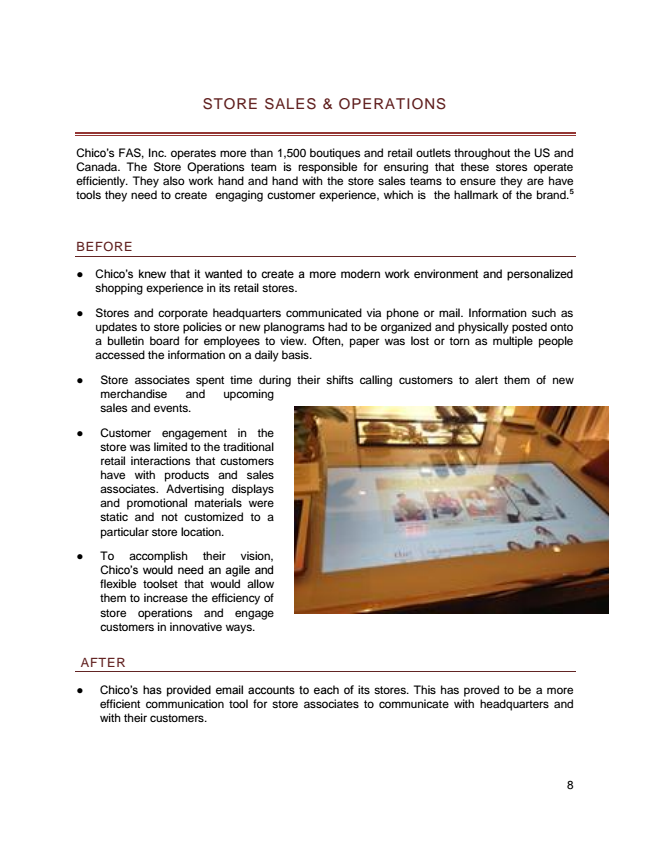
● Digital signage powered by Google Chrome for Work is a key part of the Chico’s “Digital Retail Theater” strategy, which includes bringing digital signage to stores and displaying relevant content and promotions based on the store, category, and/or season. This has created a more engaging experience for Chico’s shoppers.6
● With Google’s digital signage solution, this team can easily push out relevant content and change displays without burdening the IT department or maintaining additional hardware at each store. This team is also beginning to measure the relationship between how shoppers respond to content and the resulting impact on sales in real time, a task which was not possible prior to their adoption of Google for Work products.
IMPACT
The move to Google created a more efficient work environment for store associates and an innovative and engaging in-store experience for customers. With Google, associates spend less time searching for hard copies of communications from headquarters and have more time on the floor with customers. They are also able to connect with their customers via email which further enhances the clienteling experience. Digital signage powered by Chromebox devices have transformed the in-store experience, giving customers a new way to view and engage with merchandise and marketers the ability to test content and promotions in real time. Digital signage has allowed Chico’s FAS to create more relevant experiences in-store.

9

Sunday, July 5, 2015

Building In-DELL-ible Partnerships

It’s interesting how a simple business lunch can evolve into a collaboration of ideals that places a group at the forefront of technology.


In Late 2013, I was privileged to attend a meeting at the Capital Grille’s Board room Tampa, where I dined with Michael Dell in a private six person setting alongside fellow IT executives.


The afternoon began with a half hour general discussion with Mr. Dell’s Southeast Florida leaders, Martin Beech and Sig Hardester. We discussed HP’s existing technical footprint at my company, and how Dell could aggressively assist in configuration and cost cutting.


I saw Michael Dell walk past our room to the board room for lunch, but the three of us were so engrossed in conversation that we ran over ten minutes.  We finally wrapped up our pre-lunch discussion, and headed to the room where we would have lunch with Mr. Dell.


I walked into the dining area where Mr. Dell and the four other IT leaders were already seated. Tent cards were laid out indicating our seat assignments.  The mere proximity to this man was a bit intimidating - this is one of the pioneers of my industry!


All intimidation was immediately dissipated as Michael stood and shook my hand.  His demeanor was confident yet down to earth.  As we spoke, it was clear to see through the suit to who he really is:  a man who still possesses the nerd-like technical passion he had when he was 15 years old and took his first Apple II computer apart just to see how it worked.


Our "over lunch" discussion flowed naturally, and we touched upon many topics relating to our respective companies and general technology.  My favorite quote from our discussion is attributed to Michael Dell:  “It's through curiosity and looking at opportunities in new ways that we've always mapped our path at Dell. There's always an opportunity to make a difference.”


That lunch occurred just a few days prior to Mr. Dell taking his company private.  He graciously shared his insight regarding the world of Dell - the man and the company:


  • As one of the largest private family owned business in the USA, Dell will be more nimble and able to create and innovate at a faster rate.
  • When asked about cell phone market,  Dell indicated that his company will not be getting involved in that sector.
  • In the near future, the company’s main focus will be laptops, tablets and security devices.
  • He made it clear that his laser beam focus was towards the future, particularly in the area of memory/disc/enterprise all being closer to each other from a speed perspective. Although he didn’t mention it directly, I’d like to think that we are nearing to the quantum computing realm.(wishful thinking)


The group discussion was fascinating, but the most interesting part was my conversation with Mr. Dell that related to the evolution of computing. The conversation traversed terminal to mainframe to distributed computing, then full circle to mainframe, or worldframe.  We discussed the advent of networking, Banyan, Novell, (late 80’s), when you actually had to configure each component of a server, installing (sometimes soldering) memory chips in a motherboard, formatting hard drives, and performance-tune the Operating system to the specific business use of the server.  As time went on these activities became wizard driven,  where one would choose the business function of the server whether it be database, file service, or other business utilities- and then "push the button" and start feeding disks (mid 90’s)


After leaving the time capsule conversation, I posed the question of the smart appliance approach. "Are we nearing the time where a business can consolidate all enterprise services?” We discussed the possibility of the consolidation of network switches, servers, server clusters, storage devices, etc., into one appliance or even separate replaceable intelligent appliances that can autonomously learn, spawn, and tune the environment to make a new installation or upgrade of a major system. The amalgamation of these devices would culminate in an enterprise appliance wizard whose purpose is driven by a need to lower the overall cost, support, and complexity, while increasing optimum performance across a global organization.


Michael said, "Yeah, like enterprise in a box," which, later in the conversation, was referred to as the “easy button” concept. This ideal is an integral component in their R&D efforts.


Many technology companies are in a constant game of leapfrog to keep pace with the ever-evolving landscape (e.g., IoT). I asked Mr. Dell to expand on his R&D team structure and how many of them were actual futurists, staying out in front of the fast paced technology time curve.  He explained that he had multiple CTOs across the globe, reporting up through one governing CTO who, as part of his charter, keeps a measured segment of each group’s eye on the future, building and creating new things through very close collaboration.


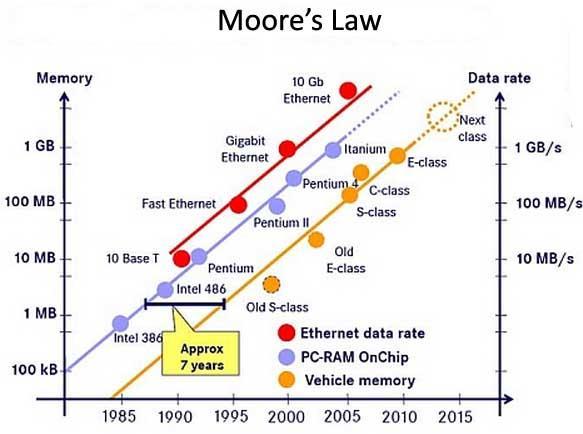
During our conversation, I realized that the overarching concept was a modern derivation of Moore’s Law, which is the observation that, over the history of computing hardware, the number of transistors on integrated circuits (IC) doubles approximately every two years. The conversation morphed into a macro version, out of the actual realm of IC’s toward the physical technical appliances housing them.


When reflecting back on the entirety of the experience, while the food was good and the conversation was better, the best part of the afternoon was a personal invitation from Michael to visit Dell’s research and development lab to be a first-hand witness to the exciting advancements the company is making in our industry.


This encounter with Mr. Dell is now one of my career highlights.


A couple of days after the luncheon, I received a personal follow up email and Linkedin connection from Mr Dell.  The email ended with “contact me directly anytime you feel I can be helpful”


I have reached out a few times since relating to new technology, but no contact with Mr. Dell has been more important or beneficial to than the one I made about my company’s security position.


After the rapid succession of breaches that impacted over dozen large corporations, it became clear that the landscape of security had been changed forever.  These breaches clearly demonstrated  that regardless of best practices and PCI compliance, there is no network or system that is 100% safe from a cyber-attack.  With this in mind, I set a goal of strengthening my company’s security posture with focus on awareness, monitoring controls, and strong vendor partnerships.
I reached back out to Mr. Dell, who put me together with the security arm of his company.  
From the very first meeting, our two organizations naturally formed a high performance work team with a hive mentality. Each and every individual contributed thought capital that lead to the creation of a program designed to meet an ever-evolving threat landscape.
The combined team concentrated their efforts on identifying key weaknesses using the Cyber Kill Chain - a variant of a military kill chain.  With focus on people, process, and best in class systems, the team swarmed and collaborated against an aggressive timeline to introduce additional security tool sets into our enterprise infrastructure. To assist with diligent monitoring, we integrated with Dell’s Security Operations Center. The added expertise of highly trained security professionals provides us with 24/7/365 staff augmentation, shortened operational cycle times, and expedited detection and eradication of attacks, vulnerabilities, and threats in our environment.  The end product is designed to be as polymorphic as the threats that exist in the wild.


Due to the proprietary nature of the implementation, I cannot disclose specific security solutions in place.  I can say that the systems generate log data that is fed to the SOC, where a secret sauce correlates millions of logs to filter data and generate truly actionable events.  We are leveraging Dell’s proprietary Counter Threat Platform, powered by their Multiple Process Logic Engine (MPLE), that processes more than 110 billion events a day, and correlates, analyzes and identifies those events down to approximately 4,000 security incidents that are escalated to clients.


At a recent TAG event, I met up with Michael and personally thanked him for brokering a business partnership that my company will benefit from for years to come. The photo below commemorates the event,  with Michael, my mentor Kent, and me. I look forward our paths crossing again in the very near future.


dellmario.png
From left to right - Kent Kleeberger, Michael Dell, and Alan Mariotti


Technology Association of Georgia: TAG


Chico’s cuts costs and goes global with Google Apps

Posted: 
Alan Mariotti, Vice President of IT and Security at Chico’s FAS Inc

Editor's note: Today’s guest bloggers are Eric Singleton, Chief Information Officer and Alan Mariotti, Vice President of IT and Security at Chico’s FAS Inc, a retailer established in 1983 with a nationwide family of brands that include Chico's, White House | Black Market, Soma Intimates and Boston Proper. See what other organizations that have gone Google have to say.

Chico’s FAS first opened its doors in 1983 in a 800 square foot tobacco shop in Sanibel Island, Florida, where folk art, sweaters and accessories from Mexico filled the store’s shelves. The clothing took off, and within two years, a second store opened nearby. Now, 30 years after getting started, we employ 22,000 people, operate 1,470 stores and own four specialty retail brands: Chico’s, White House l Black Market, Soma Intimates and Boston Proper.

Our technology changed quite a bit over the years, and in early 2013, we realized we were limping along with a very outdated email system and escalating infrastructure and storage costs. We considered our options: we could keep the status quo and upgrade from Microsoft Exchange 2003 to the 2013 version—which would cost millions—or go with a lower-cost option that would both help our distributed workforce collaborate faster and eliminate our need for resource-intensive servers. We tested Google Apps with 100 employees in one of our business groups and it passed all of our testing and scalability metrics within a few short months. The enthusiasm and efficiency gains alone convinced us it was the obvious and most cost-effective solution.

Our decision to move to Google Apps is also part of a larger cultural shift we are driving at Chico’s, where we’re looking toward technology to enable swifter innovation and invention across the company. With traditional enterprise environments, information is siloed, existing in separate servers and applications, leaving a business to operate as the sum of many independent parts. We’re moving away from this toward a more progressive hybrid cloud model, with Google at the foundation. It’s this new environment, positive feedback loops accelerate, and we can bring together multiple solutions and data sources, all built in the cloud, and look at our business holistically. That’s our vision, and Google is a big part of it.

Even though we have completed our entire enterprise deployment, our journey with Google has just begun and we’re already seeing some great benefits. Our ability to collaborate and share sensitive information across our global team has significantly improved since moving to Google Apps — and we’re saving money at the same time. Our team in Hong Kong, for example, is responsible for visiting and monitoring our factories to ensure they’re compliant with numerous security and performance standards. Before “going Google,” we found ourselves physically travelling back and forth quite often to meet and review access to important documents in person. Now, the U.S. team jumps on a Google+ Hangout with its Hong Kong counterpart, pulls up the essential information from Drive, and has a productive meeting from halfway across the world, all while resting assured that the information is safe and secure in the cloud. Additionally, cost on travel in dollars and time away from campus is greatly reduced.

The benefits of moving to Google Apps continue to reveal themselves to the global team each day. That’s part of the reason we’re so excited about our new platform: not only do we know our information is secure or that our employees are collaborating in new ways over Hangouts and in Docs—we know this is just the tip of the iceberg. We’re driving a new culture of innovation and invention, and Google is one of the cornerstones of that vision.